Planar (Spider) Glazing Systems
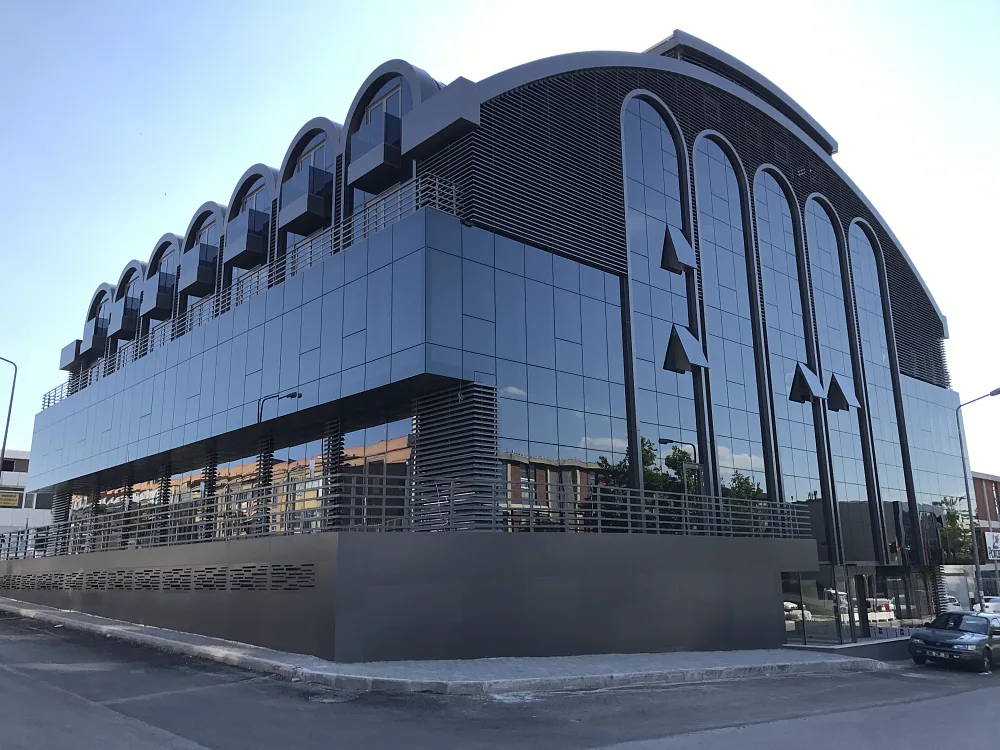
Frameless glazing in which the glass is fixed to the support structure with stainless steel rotules and spider fittings. Used where transparency matters: shop windows, showrooms and retail facades.

About the system
Planar (spider) glazing is a transparent cladding system in which the glass does not sit in a frame along its edges but is supported at points, through holes drilled near its corners. Wind load and the weight of the glass are carried by a steel or glass support structure designed together with the glass; the only things on the glass surface are the stainless steel fittings and the thin joints between them. The Gündüz Alüminyum team in Ankara installs this system on projects where the view should not be interrupted by framing.
Rotules, spiders and the support structure
The stainless steel rotules that pass through the holes in the glass have ball joints that let them rotate slightly, which limits the stress around the holes as the glass flexes under wind. The rotules are attached to stainless steel spiders whose arms reach out to the corners of neighbouring panes. How many arms a spider has depends on whether it sits at a corner of the facade, along an edge or at a point where several panes meet. The spiders are fixed to stainless or painted steel posts and beams, or to load-bearing glass fins, and the joints between the glass panels are sealed with silicone.
Point-fixed glass is made from toughened glass. Laminated glass is used where the pieces must stay in place if the glass breaks, and insulating glass units suited to point fixing are used for heated spaces. Because the holes are drilled before toughening, the size of the glass and the hole positions cannot be changed afterwards, which is why the site survey and measurements matter as much as the installation itself.
Where it is the right choice
The system is usually used not on a whole building but on the parts where transparency comes to the fore. Besides shop windows and showrooms, typical examples are building entrances, lobbies and tall, wide openings where intermediate profiles are not wanted. The rest of the facade can be clad with structural silicone glazing or a capped curtain wall, so that the effect of the planar glazing is concentrated on prominent areas such as the entrance or the shop front.
Points to consider with planar (spider) glazing
- The structure stays visible: Because the steel or glass support structure is clearly visible from inside, its sections, connection details and surface finish should be treated as part of the architectural design.
- Heat and sun: The fittings pass through the glass and form thermal bridges, and large areas of glass are exposed to heat loss in winter and to solar heat gain in summer. Given Ankara’s cold winters and hot summers, the choice of glass should be settled at the design stage.
- Glass replacement: A broken pane has to be replaced with new toughened glass of the same size and hole layout, so the time a replacement takes depends on producing it.
- Maintenance: The glass is cleaned inside and out, and the silicone joints and stainless steel fittings should be checked at regular intervals.
Facade Systems
Other services in this group.